Setting
Boundaries Worksheet
Free Printable PDF for Empaths
This Setting Boundaries Worksheet is designed to help empaths recognise when their energy is being stretched too thin and begin creating healthier emotional boundaries.
It grew out of a simple worksheet I created for myself when I first began looking for ways to support my own wellbeing after realising that my sensitivity was something I needed to understand more deeply and care for.

If you’re an empath, you may, like me, have spent years putting other people’s needs ahead of your own. You may listen deeply, offer support generously, and instinctively step in when someone is struggling. These qualities are beautiful strengths — but without healthy boundaries, they can also lead to emotional exhaustion.
Many sensitive people find themselves feeling drained after certain conversations, responsible for other people’s feelings, or unable to say “no”, even when they already feel overwhelmed and unsure how to deal with the overwhelm.
Over time, this constant giving can leave very little energy for yourself.
This worksheet is designed to help you recognise where your energy is being stretched and begin creating boundaries that support your wellbeing.
Setting Boundaries Worksheet (Printable Reflection Exercises)
This printable Setting Boundaries Worksheet offers simple reflection exercises designed especially for empaths and sensitive people.
Rather than focusing on strict rules or rigid boundaries, the worksheet helps you explore your experiences and recognise where your emotional energy may be overextended.
Inside the worksheet you will:
- Identify common patterns of over-giving and people pleasing
- Recognise situations that leave you feeling emotionally drained
- Reflect on where clearer boundaries may support your wellbeing
- Begin creating small, supportive boundaries that protect your energy
- Explore simple phrases you can use when communicating your needs
The goal is not to change everything at once.
It’s simply to begin noticing where you need a little more space, balance, and self-care — and this worksheet will help guide you through that process.
Preview of the Worksheet
Before downloading, here’s a quick look at what the worksheet includes.
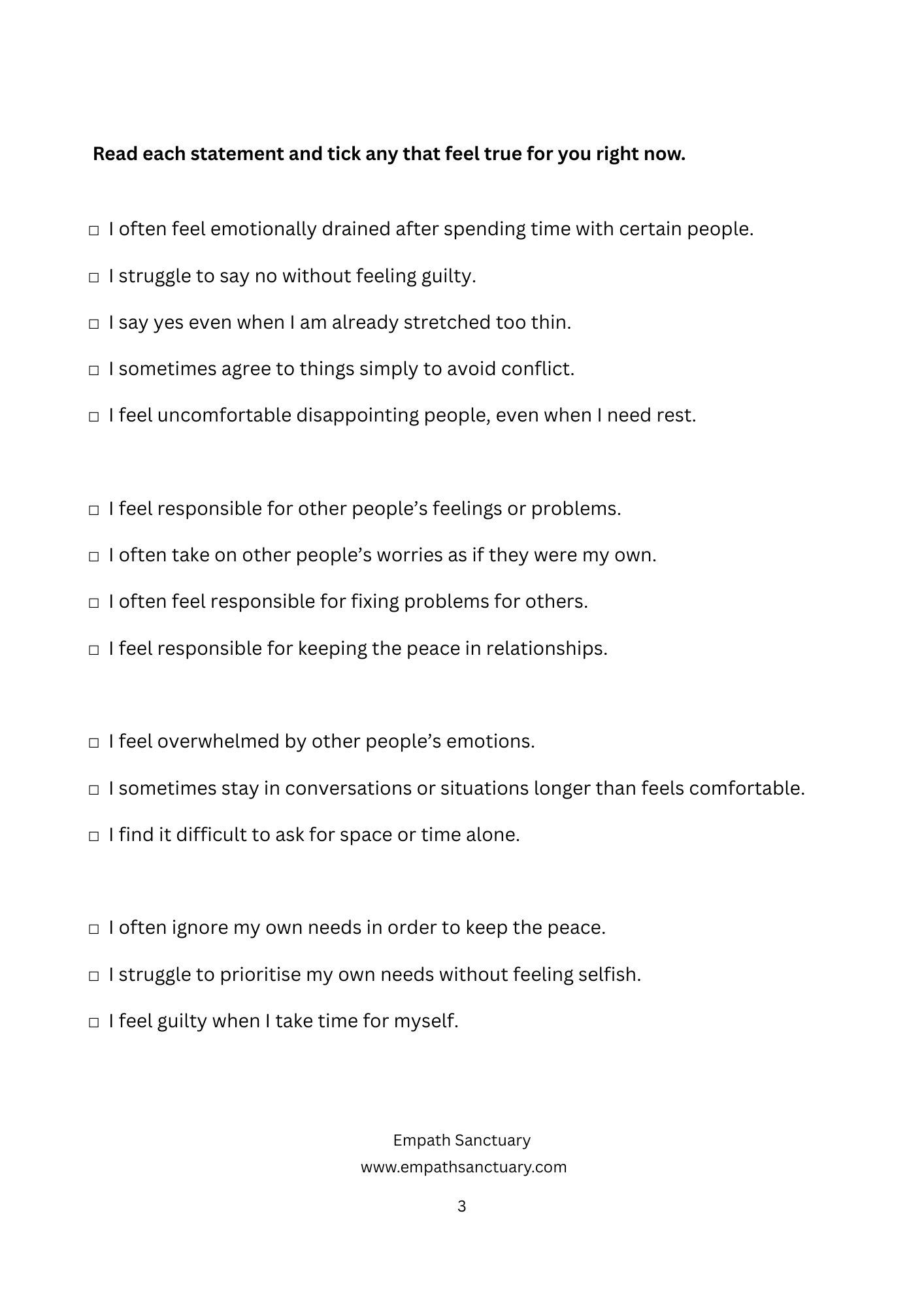
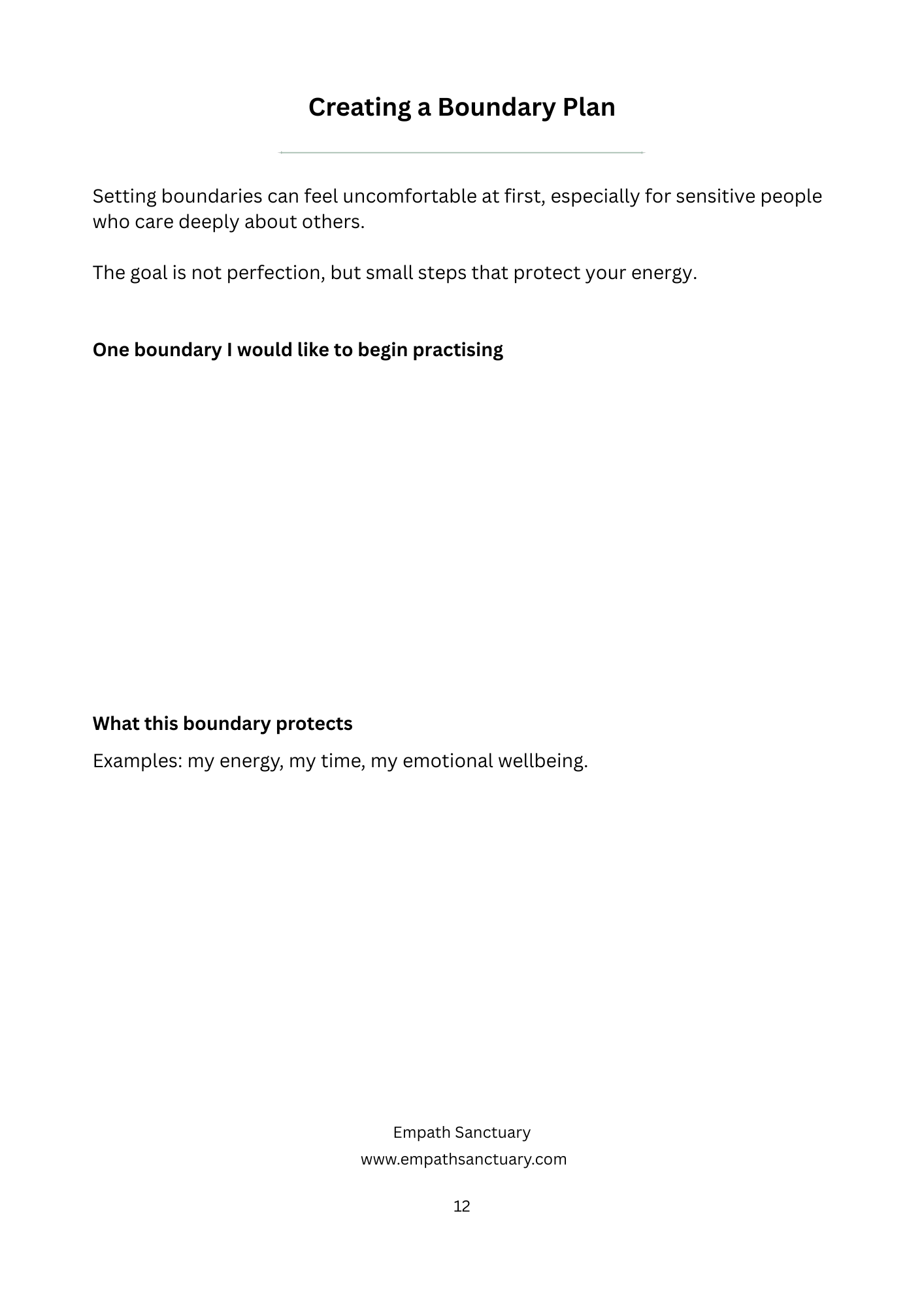
The exercises guide you through a series of gentle reflections, including:
- A Boundary Clarity Check to help you recognise common empath patterns
- Prompts to explore where your energy is being drained
- Space to reflect on situations where boundaries may be needed
- A simple Boundary Plan to help you take a small next step
- A list of gentle boundary phrases you can use in real-life situations
 |
 |
These exercises are designed to be simple and reflective, giving you space to explore your experiences and notice what feels right for you.
Download the Setting Boundaries Worksheet
Download the Setting Boundaries Worksheet (Free Printable PDF) below and use it whenever you want to reflect on your boundaries and emotional energy.
How to Use the Worksheet
Work through the exercises at your own pace.
Some people complete it in one sitting, while others return to it over several days or weeks as new insights arise.
You might find it helpful to:
- Find a quiet moment when you won’t be interrupted
- Approach the exercises with curiosity rather than self-judgement
- Write honestly about what feels true for you right now
- Revisit the worksheet later as your awareness grows
Boundary work is a gradual process. Each reflection can help you recognise where your emotional energy is being stretched and where clearer boundaries may support your wellbeing.
Why Boundaries Can Be Difficult for Empaths
Many empaths become used to focusing on other people’s needs, feelings, and comfort before their own.
This deep awareness of others can create meaningful connections, but it can also make it harder to recognise when your own needs are being overlooked.
Over time, this can show up in patterns like these:
- Feeling responsible for other people’s emotions
- Saying "yes" even when you feel overwhelmed
- Staying in draining conversations longer than you want to
- Worrying that setting a boundary might upset someone
- Feeling guilty when you take time for yourself
If this feels familiar, you’re sharing a common experience among empaths.
Learning to set boundaries is about creating a healthier balance between caring for others and caring for yourself, supported by clear emotional boundaries.
A Small Personal Reflection
Many people discover that boundaries become easier once they begin to notice how their energy shifts in different situations.
Sometimes the first sign is simply a feeling of heaviness or fatigue after interactions with certain people or being in specific situations or environments.
Before I began to recognise these signals myself, I had no idea why I would suddenly feel drained or overwhelmed.
It was only as I started to understand my empathic traits that I realised my body was telling me when a person or situation was draining my energy.
That realisation can be the beginning of a very important shift.
Instead of constantly pushing through exhaustion, you begin to listen more carefully to what your energy is telling you.
This worksheet is simply a starting point for that process.
Frequently Asked Questions
What is a setting boundaries worksheet?
A setting boundaries worksheet is a guided reflection tool that helps you recognise where your emotional energy may be overextended and where clearer boundaries may support your wellbeing. As a personal boundaries worksheet, it uses simple prompts and reflections to help you notice patterns in your relationships and daily life.
Do I need to complete the worksheet all at once?
No. Many people prefer to work through the exercises slowly, returning to different sections as new insights arise.
Is this worksheet suitable for highly sensitive people or empaths?
Yes. This worksheet was created specifically with empaths and sensitive people in mind. The exercises focus on recognising energy drains, people-pleasing patterns, and situations where healthier boundaries may help restore balance.
Continue Learning About Healthy Boundaries
There’s lots more help and support on understanding and setting boundaries in the pages below.
Each explores a different part of the boundary-setting journey for empaths and sensitive people.
Path 2 Core Pages:
- Setting Boundaries in a Relationship – Learn how to set healthy boundaries in relationships without guilt or conflict so you can protect your energy and stay connected without over-giving.
- Emotionally Drained in a Relationship? – Learn why you feel emotionally exhausted in relationships and discover practical steps to reduce overload and restore balance.
- How to Stop People Pleasing – Understand why you prioritise others over yourself, how the pattern formed, and practical steps to build healthier, more balanced relationships.
- How to Deal With Overwhelm – Practical support for empaths who feel overwhelmed or emotionally drained, with tools to help you stabilise, set boundaries, and regain balance.
- How to Calm Nervous System – Find out why emotional overload happens and discover practical ways to calm your nervous system and feel more settled.
- Setting Emotional Boundaries – Learn how setting emotional boundaries helps you stop absorbing other people’s emotions, stay present in relationships, and avoid emotional shutdown.
- Setting Boundaries Worksheet – Download a printable worksheet designed to help empaths recognise energy drains and begin creating healthier emotional boundaries.