How
to Stop Over-Giving Without Feeling Guilty
(For Empaths)
If you’re an empath, giving likely feels natural to you — but you may also find yourself over-giving, even when it leaves you drained.
You care deeply. You notice what others need. You want to help, support, comfort, and be there. And often, you do it almost automatically — which can make it hard to stop over-giving, even when it’s taking a toll on you.
But over time, that way of giving can begin to cost you.

You may start to feel tired in ways that rest doesn’t fully ease. You may notice inner resentment, emotional heaviness, or the sense that you are carrying more than is yours to carry — emotionally, mentally, or energetically.
Pulling back can feel deeply uncomfortable.
Because underneath over-giving, there is often a powerful fear:
|
If I stop, will I disappoint people? If I do less, will I still be loved? If I stop being the dependable one, who will I be?
|
This is where over-giving becomes more than simple kindness.
It becomes a pattern.
Learning how to stop over-giving without feeling guilty is about giving in a way that is honest, grounded, and sustainable.
Why Do Empaths Over-Give?
Empaths often over-give because they are deeply attuned.
You notice shifts in mood. You sense when something feels off. You pick up on what others need, sometimes before they say a word.
That sensitivity can make you incredibly caring — but it can also make it very easy to overextend yourself.
For many people, over-giving is more than a habit.
It is a learned way of relating.
At some point, you may have come to believe that being helpful made you valuable. That being easy-going kept the peace. That being available made you lovable.
That stepping in quickly prevented discomfort, conflict, or disconnection.
So giving stopped being just something you did.
It became part of who you believed you needed to be.
I’ve found this can run deeper than we realise.
You may have become:
- The reliable one
- The calm one
- The strong one
- The one who holds everything together
- The one who notices and takes care of what others miss
And when a pattern becomes identity, changing it can feel unsettling.
This isn’t just about changing what you do — you’re beginning to question an old role that may once have helped you feel safe, connected, or needed.
Sometimes over-giving is also linked to deeper beliefs, such as:
- My worth comes from what I do for others
- It’s not okay to have too many needs
- If I don’t step in, everything will fall apart
- It’s easier to focus on other people than to feel what’s happening in me
That’s why this pattern can feel so difficult to shift.
It is rarely about kindness or generosity alone. It is often tied to belonging, identity, guilt, and self-protection.
The Hidden Cost of Over-Giving
On the surface, over-giving can look generous, loving, or selfless.
But underneath, it often comes at a quiet cost.
You might notice that:
- Your needs consistently come last
- You say ‘yes’ before checking in with yourself
- You feel emotionally or physically depleted
- You give more than you genuinely have to give
- You struggle to receive support in return
- You feel responsible for keeping things okay
Over time, this can create a painful kind of invisibility.
Not necessarily because others don't care — but because you have become so used to moving yourself out of the way that your own inner life starts to fade into the background.
You may also begin to feel things you don’t want to admit:
- Resentment
- Heaviness
- Frustration
- Exhaustion
- Numbness
These feelings do not mean you are unkind.
They can mean that somewhere inside, a part of you knows the giving has become unbalanced.
Over-Giving in Relationships
Over-giving shows up most strongly in relationships.
This may be where you feel most needed, most emotionally activated, or most afraid of letting someone down.
You may find yourself giving extra time, extra understanding, extra patience, extra reassurance — long after your energy is depleted.
In relationships, over-giving can look like:
- Taking responsibility for someone else’s emotions
- Trying to keep the peace at your own expense
- Over-explaining, over-helping, or over-accommodating
- Being the one who always checks in, initiates, or smooths things over
- Ignoring your own needs because theirs feel more urgent
- Feeling guilty for wanting space, quiet, or support in return
At first, this can feel like love.
But over time, it can create an imbalance where the relationship depends on you giving more than is sustainable, and more than you receive in return.
You may start to feel:
- Unseen
- Drained
- Over-responsible
- Quietly resentful
- Afraid to ask for what you need
Part of shifting this pattern is recognising that not everything is yours to carry, fix, or solve.
Sometimes love is supportive and attentive.
But sometimes love also means letting another person have their own feelings, responsibilities, lessons, or discomforts — without rushing in to manage them.
That can feel uncomfortable at first.
Especially if you’re used to being the one who keeps everything together.
But it can be the beginning of a healthier, more honest kind of connection.
Real connection does not require self-abandonment.
Why Guilt Shows Up When You Try to Stop Over-Giving
Guilt is one of the main reasons this pattern continues.
The moment you pause, pull back, say ‘no’, or consider your own needs, guilt can quickly rise.
But guilt doesn’t always mean you’re doing something wrong.
Sometimes, it simply means you’re doing something unfamiliar.
If being very helpful has been your way of feeling safe, then beginning to consider your own needs may feel uncomfortable at first.
If you are used to being available, responsive, and accommodating, boundaries may feel unnatural before they feel healthy.
That discomfort is real — but it doesn’t mean you need to go back to how things were.
It’s a sign that an old pattern is being interrupted.
It can also help to remember this:
People who benefited from your over-giving may not immediately like the changes you begin to make.
They may be surprised. They may be disappointed. They may even try to pull you back into your old role.
That does not automatically mean your boundary is unreasonable.
|
You can disappoint someone and still be a caring person. You can care deeply and still have limits. You can feel guilt without acting from it. |
The Difference Between Giving and Over-Giving
Not all giving is the same.
Healthy giving usually feels:
- Intentional
- Comfortable
- Grounded
- Sustainable
- Freely offered
Over-giving often feels:
- Automatic
- Pressured
- Draining
- Fear-based
- Difficult to stop
Healthy giving tends to come from a place where you have the space and energy to give.
Over-giving often comes from urgency, guilt, fear, or the need to preserve connection.
A simple question that can help is:
Am I giving from fullness — or from fear?
Another question to ask is:
Can I offer this and still feel okay in myself?
These questions are not about giving less or withdrawing from others.
They are about being honest with yourself.
How to Stop Over-Giving Without Feeling Guilty
This is about giving in a way that feels balanced and true to you.
|
It is about shifting from reactive giving to intentional giving. It is about learning to stay connected to yourself while you care for others. |
Here are some gentle ways to begin.
1. Pause before you say ‘yes’
Over-giving tends to happen quickly — before you’ve really checked in with yourself.
Give yourself a little space before agreeing.
You might say:
- “Let me think about that.”
- “I need to check what I’ve already got on.”
- “I’m not sure yet — let me come back to you.”
A pause interrupts the old pattern and gives your inner truth a chance to catch up.
This is something I still have to remind myself to do.
2. Check in with your body, not just your mind
Before you agree to something, notice what’s happening inside you.
Do you feel:
- Open or tight?
- Steady or pressured?
- Willing or obligated?
- Calm or resentful?
Your body often tells the truth earlier than your thoughts do.
If your ‘yes’ comes with heaviness, dread, or tightening, it may not be a true ‘yes’.
3. Notice where over-giving is most activated
Not every situation triggers the pattern equally.
Pay attention to the people, relationships, or environments where you most often feel:
- Drained
- Guilty
- Resentful
- Over-responsible
- Anxious about disappointing someone
These are often the places where your over-giving pattern is strongest.
Awareness helps you see that this is not simply “who you are.”
It is something that becomes activated in certain dynamics.
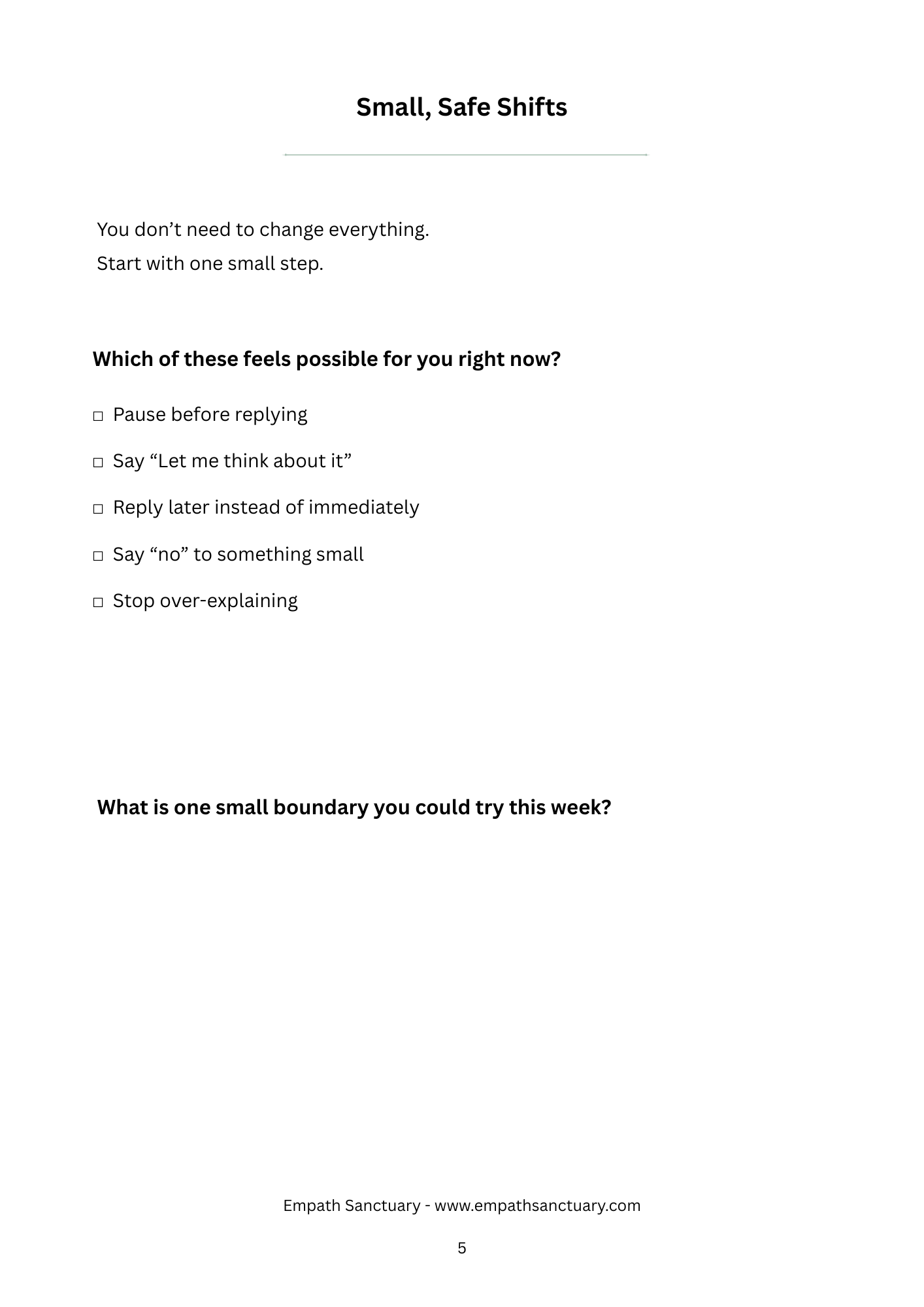
4. Start with small, safe boundaries
You do not need to change everything at once.
Begin in ways that feel manageable:
- Let a call go to voicemail
- Reply later instead of immediately
- Decline something minor
- Stop over-explaining your ‘no’
- Ask for more time before deciding
Small boundaries help your nervous system learn that you can choose differently and still be okay.
5. Let people have their own feelings and responsibilities
This can be one of the hardest shifts.
If you are used to smoothing things over, jumping in quickly to help, or protecting others from discomfort, stepping back may feel unkind.
But constantly rescuing, over-managing, or over-carrying is not always support.
Sometimes, the most loving thing is to stop taking over what was never yours to take on.
This does not mean becoming detached or uncaring.
It means recognising that other people are allowed to have their own process — and you are not responsible for it.
6. Allow guilt to be there without letting it guide your decisions
The goal is not to eliminate guilt completely.
The goal is to stop treating guilt as proof that you’ve made the wrong choice.
Gently remind yourself:
|
I can feel guilt and still choose what is right for me. I can care deeply without overextending myself. I do not have to abandon myself to prove I am loving. |
Guilt softens over time as your nervous system learns that you can set boundaries and still be okay.
7. Practise receiving, not only giving
Receiving does not always come naturally to empaths, and this has certainly been true for me.
Many over-givers are far more comfortable offering support than receiving it, so learning to receive support is an equally important shift.
This might mean:
- Letting someone do something for you
- Accepting kindness graciously
- Asking for support before you are at breaking point
- Noticing where you still believe you should handle everything alone
Receiving can feel vulnerable.
But it helps loosen the identity of always being the one who gives and who takes care of everything.
8. Redefine what it means to be a good person
For many empaths, this is the deeper work.
Being a good person isn’t about:
- Always saying ‘yes’
- Always being available
- Always putting others first
- Always carrying more than is fair
- Always being the strongest one in the room
It can mean:
- Being honest about your limits
- Respecting your own energy
- Choosing what you genuinely want to give
- Letting your care come from choice rather than habit
You are allowed to be human.
You are allowed to have needs, limits, tiredness, and seasons where you can’t do it all.
What Begins to Change When You Stop Over-Giving
As you begin to shift this pattern, something important happens.
You do not become less loving.
|
You become more real. Your giving becomes clearer. Your ‘yes’ becomes more sincere. Your ‘no’ becomes easier. Your energy is no longer scattered in so many directions. And you begin to notice where things feel more balanced in your relationships — and where they don’t. |
You may notice:
- A greater sense of steadiness in your energy
- Less resentment
- Greater self-trust
- Clearer boundaries
- More honesty in relationships
- More room to breathe, rest, and feel
You may also begin to feel something you haven’t felt in a while:
yourself.
A Gentle Reflection
You don’t have to untangle this pattern or stop over-giving all at once.
Simply becoming aware of the pattern is already a meaningful step.
But it might help to think about these questions:
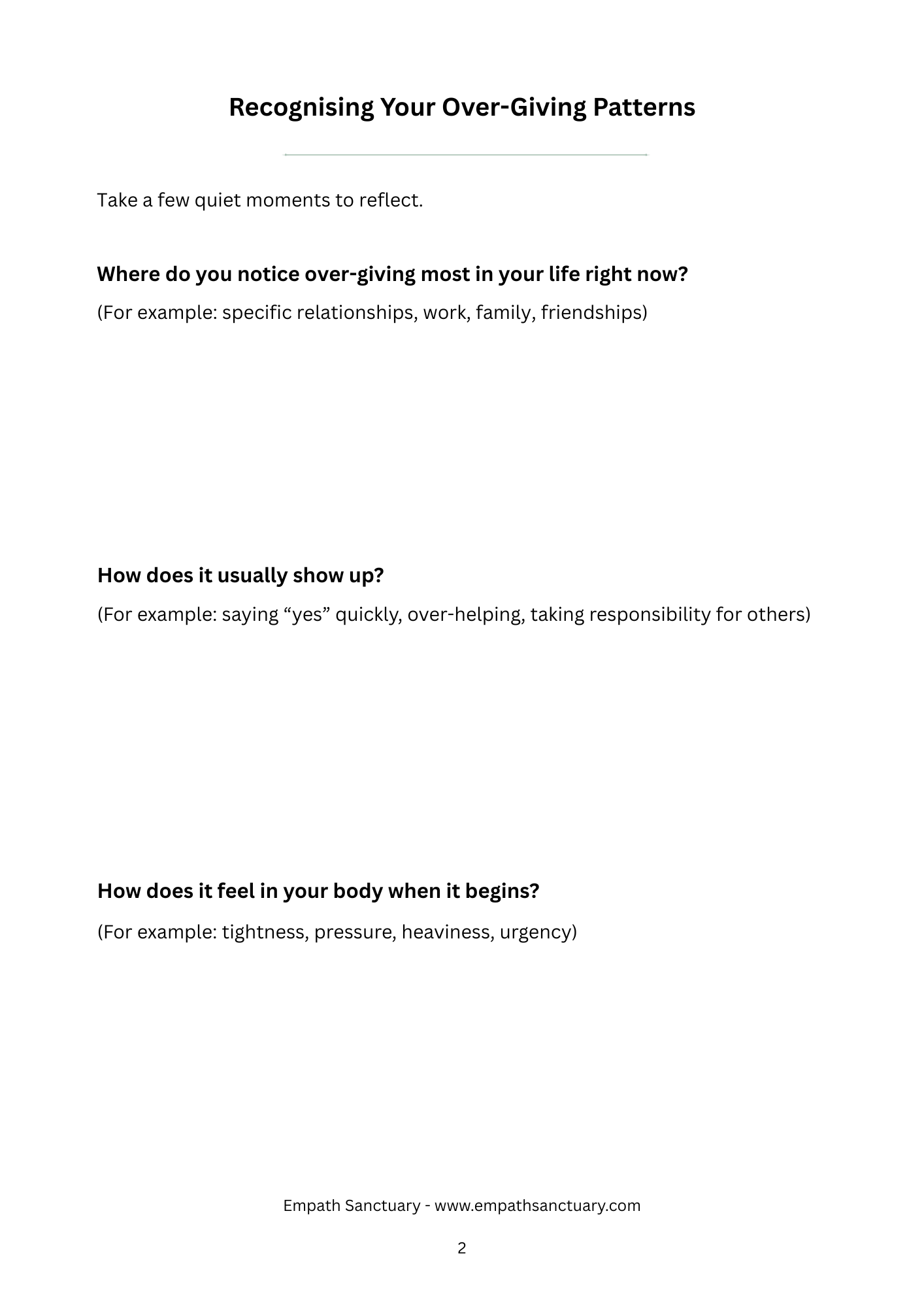
- Where in my life am I over-giving most right now?
- What do I fear might happen if I give less?
- Who have I become in relationships where I over-function?
- What am I still trying to earn through being helpful?
- When I’m about to say ‘yes’ to something, am I leaving myself out of the picture?
- What would more honest, sustainable giving look like here?
Take a few quiet minutes to reflect on them honestly.
You don’t need to find perfect answers.
Just let your responses surface naturally, and give yourself time to reflect on what they show you.
If you’d like a simple worksheet (Free Printable PDF) to help you reflect on these patterns and begin making small shifts, you can download A Guide to Stop Over-Giving below.
Here’s a glimpse inside the worksheet:
 |
 |
Closing Reframe
Over-giving was never a flaw.
It was a way of trying to care, to stay connected, and to make things feel okay.
But you don’t have to keep doing it at your own expense.
|
You are allowed to care about others and still take care of yourself. You are allowed to give without giving more than you have. You are allowed to have limits, needs, and space. And you are allowed to begin doing things differently. |
Not all at once.
Not perfectly.
I can promise this does get easier with practice — I’ve seen that in my own life.
Just one small, honest choice at a time.
That is how change begins.
Continue Exploring Path 3
As you begin to see your patterns more clearly, you may feel ready to explore a little deeper.
You don’t need to go in order—just follow what feels most relevant to you.
You might want to explore:
- Becoming an Empowered Empath – Explore the deeper patterns shaping your responses as an empath, and learn how to move beyond coping into lasting change.
- Why Do I Keep Repeating the Same Patterns? – Understand why patterns continue even when you’re aware of them, and begin to recognise how deeper conditioning shapes your responses.
- How Your Past Shapes Your Patterns as an Empath – Explore how earlier experiences influence the patterns you carry, and begin to see how they shape your responses and relationships today.
- Why Do I Feel Stuck? Understanding the Hidden Patterns That Keep You Stuck – Understand why you can see your patterns but still feel unable to change them, and begin to shift them through awareness and small, lasting changes.
- How to Stop Over-Giving Without Feeling Guilty – Understand why over-giving becomes a pattern for empaths, and begin learning how to give in a way that feels more balanced, sustainable, and true to you — without guilt or self-abandonment.
- Emotional Responsibility In Relationships: What’s Yours and What Isn’t – Clarify the difference between caring and carrying, and begin to separate what you feel from what you take on in your relationships.
- Setting Boundaries That Stick: Why They Don’t Hold & How to Change It – Understand why boundaries can be difficult to maintain, and begin to strengthen them from within in a way that feels more natural, steady, and lasting.
- What Is Shadow Work? A Gentle Introduction for Empaths – A gentle introduction to shadow work, helping you understand the hidden parts of yourself and how they quietly shape your thoughts, feelings, and patterns.
- How to Trust Yourself as an Empath (Without Constant Self-Doubt) – Understand why self-trust can feel difficult as an empath, and begin to reconnect with your intuition and listen to your own inner guidance with more clarity and confidence.
Each page builds on your growing understanding, helping you move from recognising patterns… to gently beginning to change them.
You don’t have to do this all at once—each layer of awareness brings its own shift.