What Is Shadow Work?
A Gentle Introduction for Empaths
What is shadow work?
Shadow work is the process of becoming aware of the parts of yourself that have been pushed aside, ignored, or kept out of view — often without you even realising it.
These can include thoughts, emotions, reactions, or behaviour patterns that developed over time, especially in moments when it didn’t feel safe, supported, or possible to fully express yourself.
At its core, shadow work is about self-awareness, not trying to fix yourself.
It doesn’t mean digging into anything overwhelming or forcing yourself to revisit the past. Instead, it’s about learning to notice what’s already present — the patterns, triggers, and responses that quietly shape your everyday experience.
You might find yourself saying “yes” when you really want to say “no”…

Feeling responsible for how other people feel…
Or giving more of yourself emotionally than you really have to give, then wondering why you feel so drained.
You may notice certain patterns repeating in your relationships, or that some of your reactions feel stronger than the moment calls for. And part of you may sense that something beneath the surface is shaping how you respond, even if you can’t quite explain it.
For empaths, this can feel especially familiar. When you’re used to tuning in to everyone else, it’s easy for your own needs, feelings, and responses to slip into the background without being fully seen.
Shadow work offers a way to gently turn that awareness inward — so you can begin to understand yourself with more clarity and compassion.
What Is Shadow Work?
When I was first asking the question what is shadow work, I felt a little hesitant. The word “shadow” sounded dark and mysterious to me, and I wasn’t sure what I might discover. But it turned out to be much gentler than I expected.
At its simplest, shadow work is the practice of noticing and understanding the hidden parts of yourself that were shaped earlier in your life and still influence how you think, feel, and respond.
These hidden parts are not “dark” in a frightening sense. More often, they’re parts of you that didn’t feel safe, welcome, or acceptable at some point in your life.
This might include:
- Feelings you learned to suppress
- Needs you stopped expressing
- Parts of your personality you toned down to keep the peace
- Emotional responses that developed to protect you
Over time, these parts can slip out of conscious awareness — into what we call the shadow. But even when unseen, they can still shape your life in quiet but powerful ways.
They may show up as:
- Overgiving
- People-pleasing
- Guilt around rest
- Fear of conflict
- Difficulty receiving support
- Emotional reactions that feel stronger than the moment calls for
Shadow work is not about judging these parts of yourself.
It is about learning to notice and understand them, so they no longer remain unseen.
Shadow Work Meaning for Empaths
For empaths, shadow work often has an extra layer.
Many sensitive people learn early on to focus on what others need, what others feel, and how to keep things calm around them. In that process, their own anger, hurt, fear, sadness, or needs may get pushed into the background.
You may have learned to be:
- The easy one
- The understanding one
- The helper
- The one who doesn’t ask for much
- The one who smoothes things over
These roles can feel natural after a while. But they can also hide parts of you that need care and attention.
For an empath, shadow work can mean beginning to ask yourself questions like:
- Why do I ignore my needs until I feel exhausted?
- Why do I often feel responsible for how others feel?
- When do I keep putting my own needs aside?
- Why does rest sometimes bring up guilt for me?
- What makes it difficult for me to say “no”?
- Why do certain people or situations affect me so strongly?
Understanding what shadow work is can help you begin to recognise these patterns more clearly, without blaming yourself for them.
Shadow work for empaths is about becoming more whole, so your care for others no longer comes at the cost of yourself.
Why Shadow Work Can Feel Uncomfortable
For some people, the idea of shadow work can bring up a sense of discomfort.
That’s completely understandable.
If you’re sensitive and already feel a lot, you may worry that looking inward could feel like too much. You might wonder whether it will stir up more than you can handle, or whether you’ll uncover something difficult or overwhelming.
But shadow work doesn’t have to be approached that way.
It isn’t about pushing yourself beyond what feels manageable. It’s about gently noticing what is already present in your everyday life, and allowing yourself to become more aware of it, one small step at a time.
For many empaths, the most supportive way to begin is not by going deeper. It is by slowing down enough to notice your patterns without judgement.
I left off exploring my shadow far longer than I now wish had been the case. Why? Because I was afraid I’d be opening a Pandora’s box of my deepest hurts and parts of myself I didn’t want to face.
When I finally found the courage to begin, it was a huge relief to discover it wasn’t like that at all. Instead, it became the beginning of a journey of self-discovery and healing — one I’m still following. Yes, there are ups and downs, but it has never been as overwhelming as I once imagined.
How the Shadow Shows Up in Everyday Life
The shadow often reveals itself quietly.
Not in dramatic moments, but in familiar patterns that keep repeating.
You may notice it when you:
- Say “yes” even when your body is asking for “no”
- Feel drained after helping someone, but guilty for wanting space
- Become upset more quickly than the situation seems to warrant
- Hide your anger because it feels unsafe or uncomfortable to express
- Judge certain traits in others very strongly
- Give and give, then feel hurt when it is not returned
- Minimise your needs while staying highly aware of everyone else’s
These experiences don’t mean you are failing. They may simply be signs that a hidden part of you is asking to be seen.
Sometimes the shadow contains pain. Sometimes it contains fear. Sometimes it contains qualities you had to hide long ago — confidence, self-expression, anger, tenderness, need, even joy.
Shadow work helps you begin to notice what has been pushed down, so you can understand it rather than keep reacting from it.
Why Shadow Work Matters
When hidden parts of you stay unseen, they can quietly shape your choices.
|
You may keep repeating the same relationship dynamics. You may keep overextending yourself. You may keep abandoning your own needs in order to stay connected to others, be liked, or feel safe in the relationship. |
Over time, that can leave you feeling confused, drained, resentful, or disconnected from yourself.
This is why shadow work matters.
It helps you understand what truly belongs to you, what you may have taken on from others, and which patterns no longer need to shape your life.
For empaths, this can be deeply supportive because it can help you:
- Recognise emotional patterns more clearly
- Respond rather than react
- Separate your own feelings from the energy you’ve absorbed from others
- Build boundaries with less guilt
- Relate to yourself with more honesty and compassion
This work is about building greater self-awareness and taking better care of yourself.
Benefits of Shadow Work
Doing shadow work can lead to significant changes over time.
You may start to experience:
- More self-awareness about your triggers and patterns
- Better emotional boundaries
- Less guilt around protecting your energy
- Greater compassion for parts of yourself you once judged
- Healthier relationships rooted in honesty rather than self-abandonment
- More self-trust in the choices you make
- A stronger sense of what emotional energy is yours and what belongs to others
These shifts may be subtle at first, but they can make a real difference in how you feel and respond.
|
They can mean pausing before automatically saying “yes”. They can mean noticing anger before it turns into resentment. They can mean giving yourself permission to have needs too. |
Understanding what shadow work is isn't about changing who you are.
It is about relating to yourself in a more honest and supportive way.
How to Start Shadow Work Gently
If you’re new to shadow work, the most important thing to remember is this:
You can begin in a simple, manageable way.
Shadow work for beginners is most helpful when it stays grounded and doesn’t feel overwhelming. Gentle reflection is far more supportive than trying to push yourself too far.
An easy place to start might look like this:
- Notice a repeating emotional pattern
(for example, feeling guilty when you say “no”, or drained after certain interactions)
- Pay attention to what tends to trigger you
(such as strong reactions to particular people, comments, or situations)
- Pause before reacting when something feels charged
(even taking a breath before responding can create space)
- Ask what feeling may be underneath the surface
(is it frustration, fear, hurt, or something else?)
- Stay curious instead of critical
(try asking “what might be going on here?” rather than judging yourself)
You don’t need to solve everything. You don’t need to uncover your whole history. You only need to begin paying attention.
A few minutes of honest reflection can be enough.
Simple Shadow Work Examples
If the idea still feels a little unclear, here are a few examples of what shadow work can look like in everyday life.
|
You notice that you feel irritated whenever someone is direct with you. Instead of dismissing the feeling, you pause and ask yourself whether directness feels uncomfortable because it once led to criticism or conflict. You realise you often agree to things you don’t want to do. Rather than blaming yourself, you begin exploring whether saying “no” once felt risky or led to disapproval. You feel unusually upset when someone overlooks your effort. Instead of brushing it off, you ask whether a hidden part of you is longing to feel valued and seen. |
These moments are small, but powerful. They shift the focus from self-judgment to self-understanding.
That is the heart of shadow work.
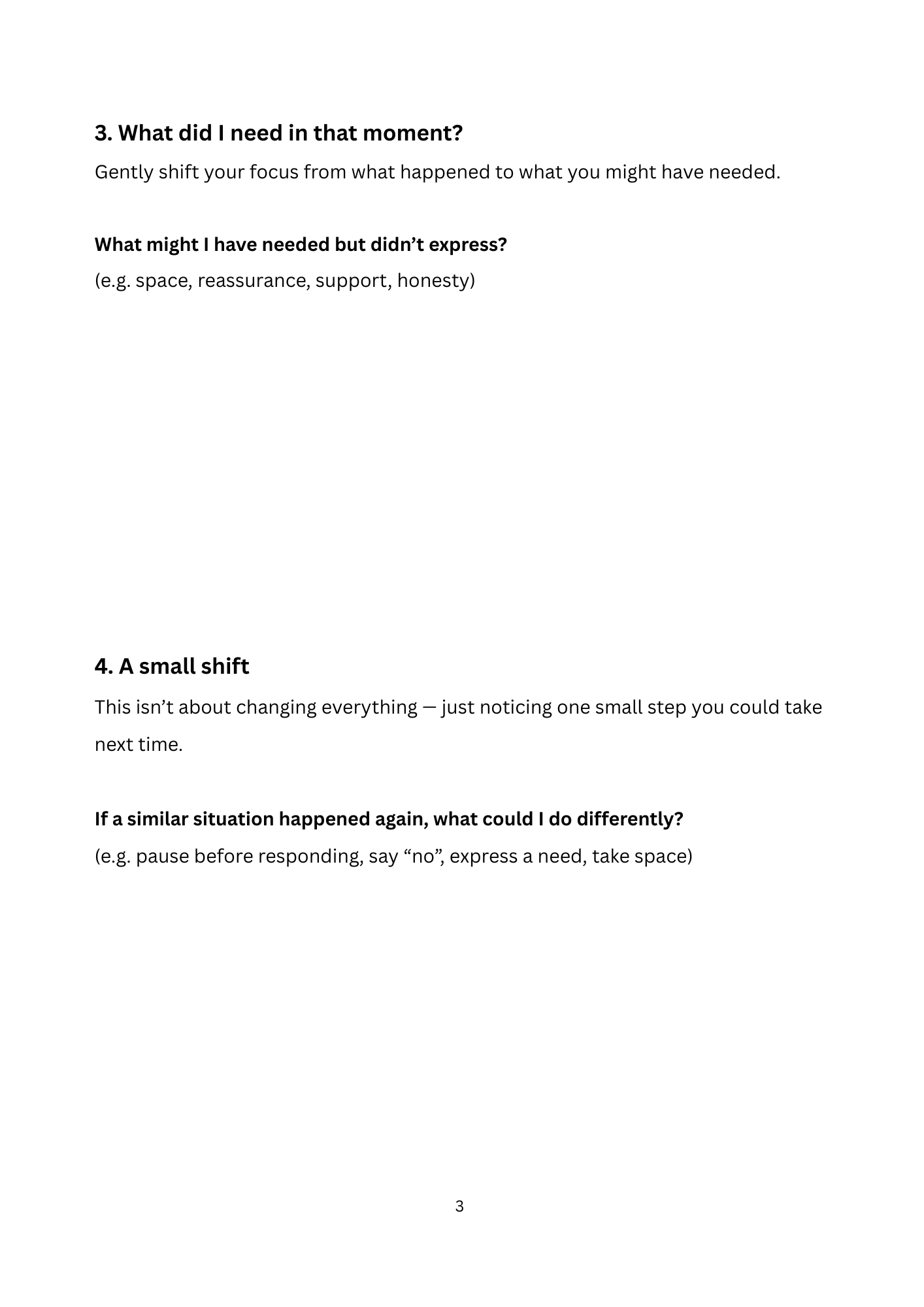
If you’d like a simple way to begin, you can use this gentle reflection sheet (free printable PDF) to explore one small pattern or feeling at a time.
Here’s a glimpse inside the worksheet:
 |
Journaling for Shadow Work
If writing helps you process, journaling can be one of the gentlest ways to begin shadow work.
It gives you space to slow down, notice what’s rising, and put words to what may have been sitting quietly beneath the surface.
The best approach is to keep it simple:
- Choose one feeling, trigger, or pattern
- Write without editing yourself
- Notice what memories, beliefs, or fears seem connected
- End by taking a moment to pause, rather than pushing for a breakthrough
You don’t need to write for long. Even ten quiet minutes can be enough.
The aim is simply to build a more honest relationship with your own inner world.
If you’re not sure where to begin, here are a few beginner-friendly shadow work questions to help guide your reflection.
Shadow Work Questions for Gentle Self-Reflection
You don’t need to answer everything at once. Start with one question that resonates with you.
- When do I feel most emotionally activated, and what might be underneath that?
(for example, feeling unusually upset by a small comment or situation)
- What do I often hide, downplay, or keep to myself?
(such as your needs, opinions, or certain emotions)
- Which emotions feel hardest for me to allow?
(for example, anger, sadness, or even joy)
- Where in my life do I keep giving more than I comfortably can?
(such as in certain relationships or responsibilities)
- What kind of situations tend to leave me feeling small, guilty, or unseen?
(for example, being dismissed, overlooked, or not listened to)
- What part of me may be asking for attention, care, or honesty right now?
(this might show up as tiredness, frustration, or a need for space)
- What trait in others strongly affects me, and why might that be?
(for example, feeling irritated by someone’s confidence or directness)
Let the questions open space rather than demand answers. This is about listening, not pushing yourself to figure everything out.
A Gentle Word of Caution
Shadow work can be meaningful, supportive, and even transformative, but it’s important to approach it in a way that feels safe for you.
If you’ve experienced significant trauma, or if self-reflection sometimes leaves you feeling overwhelmed, it can help to have some support around you as you begin.
This might mean:
- Talking things through with a therapist or counsellor
- Sharing your reflections with someone you trust
- Or simply making sure you’re not working through difficult feelings on your own
You don’t have to push yourself further than feels manageable.
Take things slowly, pause when you need to, and stay within what feels manageable for you.
For empaths especially, keeping this work simple and well-supported can help you move through it more comfortably.
A Reminder as You Begin
Now that we’ve explored what shadow work is, I want to leave you with a few gentle reminders.
|
You don’t have to force yourself into deep waters to begin this work. You don’t have to expose every hidden part of yourself all at once. You don’t have to rush toward insight. |
You can take this one small step at a time.
What matters is your willingness to understand yourself a little more clearly, in a way that feels manageable.
Shadow work is a way of making room for more of who you already are.
And for empaths, that can feel reassuring — even a relief.
Because the more gently you understand your own inner world, the less likely you are to lose yourself in everyone else’s.
Continue Exploring Path 3
As you begin to see your patterns more clearly, you may feel ready to explore a little deeper.
You don’t need to go in order—just follow what feels most relevant to you.
You might want to explore:
- Becoming an Empowered Empath – Explore the deeper patterns shaping your responses as an empath, and learn how to move beyond coping into lasting change.
- Why Do I Keep Repeating the Same Patterns? – Understand why patterns continue even when you’re aware of them, and begin to recognise how deeper conditioning shapes your responses.
- How Your Past Shapes Your Patterns as an Empath – Explore how earlier experiences influence the patterns you carry, and begin to see how they shape your responses and relationships today.
- Why Do I Feel Stuck? Understanding the Hidden Patterns That Keep You Stuck – Understand why you can see your patterns but still feel unable to change them, and begin to shift them through awareness and small, lasting changes.
- How to Stop Over-Giving Without Feeling Guilty – Understand why over-giving becomes a pattern for empaths, and begin learning how to give in a way that feels more balanced, sustainable, and true to you — without guilt or self-abandonment.
- Emotional Responsibility In Relationships: What’s Yours and What Isn’t – Clarify the difference between caring and carrying, and begin to separate what you feel from what you take on in your relationships.
- Setting Boundaries That Stick: Why They Don’t Hold & How to Change It – Understand why boundaries can be difficult to maintain, and begin to strengthen them from within in a way that feels more natural, steady, and lasting.
- What Is Shadow Work? A Gentle Introduction for Empaths – A gentle introduction to shadow work, helping you understand the hidden parts of yourself and how they quietly shape your thoughts, feelings, and patterns.
- How to Trust Yourself as an Empath (Without Constant Self-Doubt) – Understand why self-trust can feel difficult as an empath, and begin to reconnect with your intuition and listen to your own inner guidance with more clarity and confidence.
Each page builds on your growing understanding, helping you move from recognising patterns… to gently beginning to change them.
You don’t have to do this all at once—each layer of awareness brings its own shift.